
Known author
Every entry is signed. You know which party wrote it, not just which system.
SignatureIllustrative example
Illustrative example: the transfer agent signs entry #0417, so the entry shows it was signed by the transfer agent.

Product
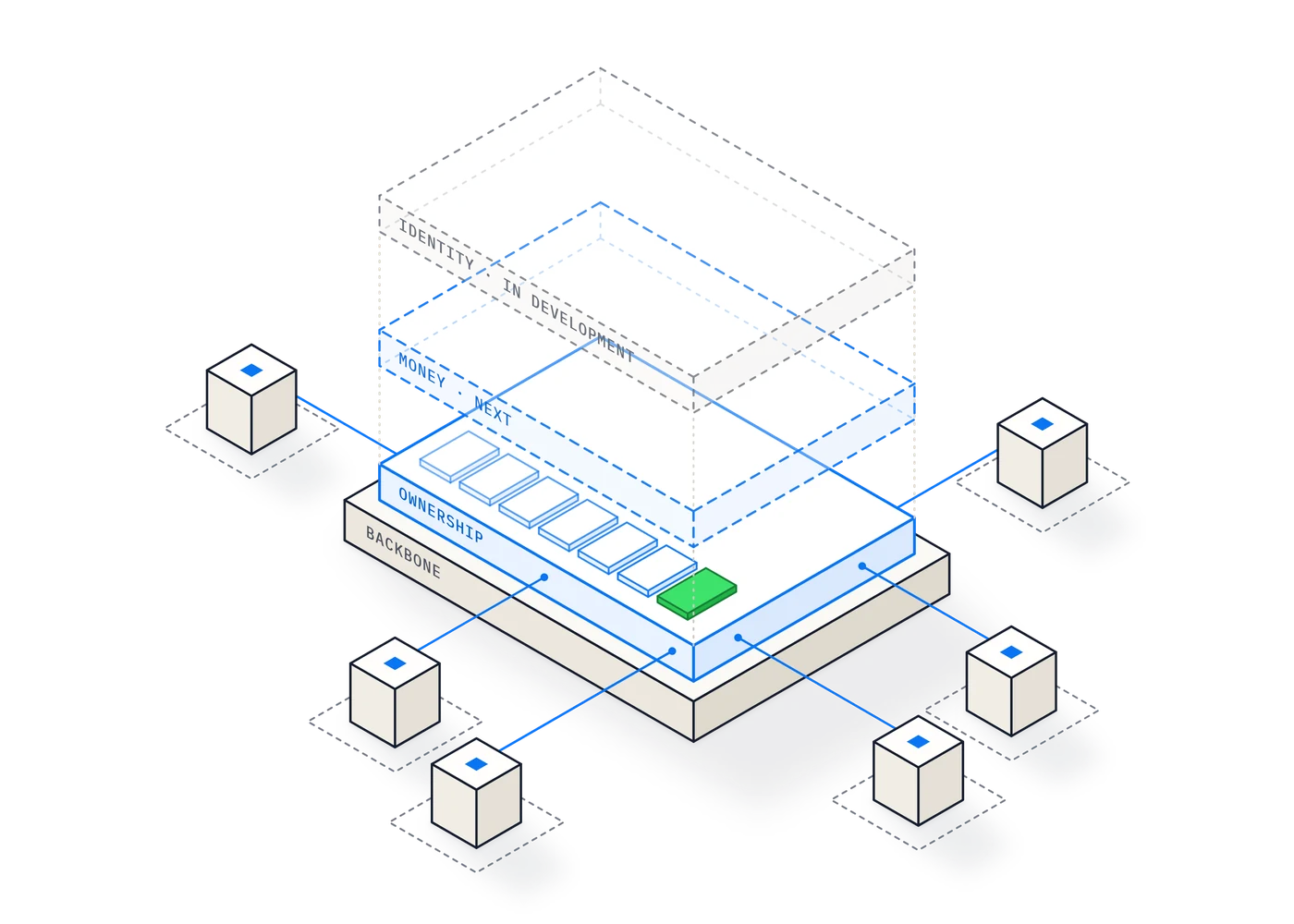
Four properties make a record reliable between firms. One backbone holds every register on top.
How it works
What does a record need so that firms that don’t share an owner can rely on it without reconciling? Four things.
Subscription#0417
Example Fund · Class A
Every entry is timestamped when it happens, not when the batch runs.
Illustrative example: entry #0417 carries the timestamp 09:42:17 CET, the moment the subscription happened. The nightly batch at 23:00 is not its timestamp.
Any change to a record is detectable. An audit becomes a query, not a reconstruction.
Illustrative example: entry #0417 is written with 1,000.00 units. If it is later presented as 1,500.00 units, its fingerprint changes from 7f3a…c21e to e04b…91d7, so the alteration is detectable.
Eligibility, lock-ups and transfer restrictions run before anything moves. A wallet that isn’t eligible doesn’t receive.
Illustrative example: units move through an eligibility check. Wallet A is eligible and receives them. Wallet B is not eligible, so the transfer to it is blocked by the rule.
What we don’t claim
A shared ledger isn’t “more secure” in the ordinary sense: it doesn’t replace perimeter defence or access control. What it gives is tamper evidence and non-repudiation across organisational boundaries. No centralised system can offer that.
Architecture
Each new register is an addition to the same backbone. Never a migration.
Who owns what, signed by the party that recorded it. Cash settles on existing rails.
Money that settles against ownership in one transaction, whatever the instrument.
Verify once, invest across every connected issuer.
We aren’t betting on which instrument wins. We’re building the thing that doesn’t care.
One register
A €50 million ticket and a €500 ticket differ by eligibility parameters, not by platform.
ELTIF 2.0 and evergreen structures erase the line between retail and institutional. Run two systems and you end up reconciling between them.
Illustrative example. A pension fund subscribes €50,000,000 and a private investor subscribes €500. Both use the same transaction structure (order, rule set, signed entry) and are appended to the same register. Each ticket is evaluated against its own rule set: rule set A for the professional investor, rule set B for the retail investor.
€50m€50,000,000
Subscription order
€500€500
Subscription order
Order
€50m€50,000,000
Subscription order
€500€500
Subscription order
Rule set
Signed entry
Register
A position on a shared register can move directly between two eligible investors, with eligibility enforced at execution, on a register the depositary can read.
Illustrative example of a capability of the architecture. A position moves from Investor A to Investor B through an eligibility check that runs at execution. The transfer is appended to the same register, and the depositary reads that register.
Bring the operation that costs you most. We’ll show you how it runs on one shared record.
